contents
- mistake 1: mistaking the logo for the brand
- mistake 2: branding before positioning
- mistake 3: copying the category leader
- mistake 4: inconsistency resets the recognition counter
- mistake 5: designing for today's startup, not the one you're building
- mistake 6: treating packaging and touchpoints as afterthoughts
- mistake 7: outsourcing the decision, not just the craft
- quick answers
Branding mistakes startups make rarely show up as ugly logos. They show up as confused customers, stalled growth, and rebrands nobody planned to pay for. The seven below are specific, recoverable, and more common than any founder wants to admit.
We have worked with enough early-stage founders to know how these patterns start. The logo commission feels like a milestone. The brief says 'modern, clean, premium'. The designer delivers something that looks fine in isolation. Then the brand disappears the moment it meets the real world — the packaging shelf, the Instagram grid, the sales deck.
The logo isn't the mistake. Treating the logo as the brand is.
mistake 1: mistaking the logo for the brand
A logo is a signature, not a personality. It is useful, compact, legally protectable — and completely mute on its own. The brand is the whole system: the colour palette, the type hierarchy, the tone of voice, the way the invoice looks, the hold music if you have a support line.
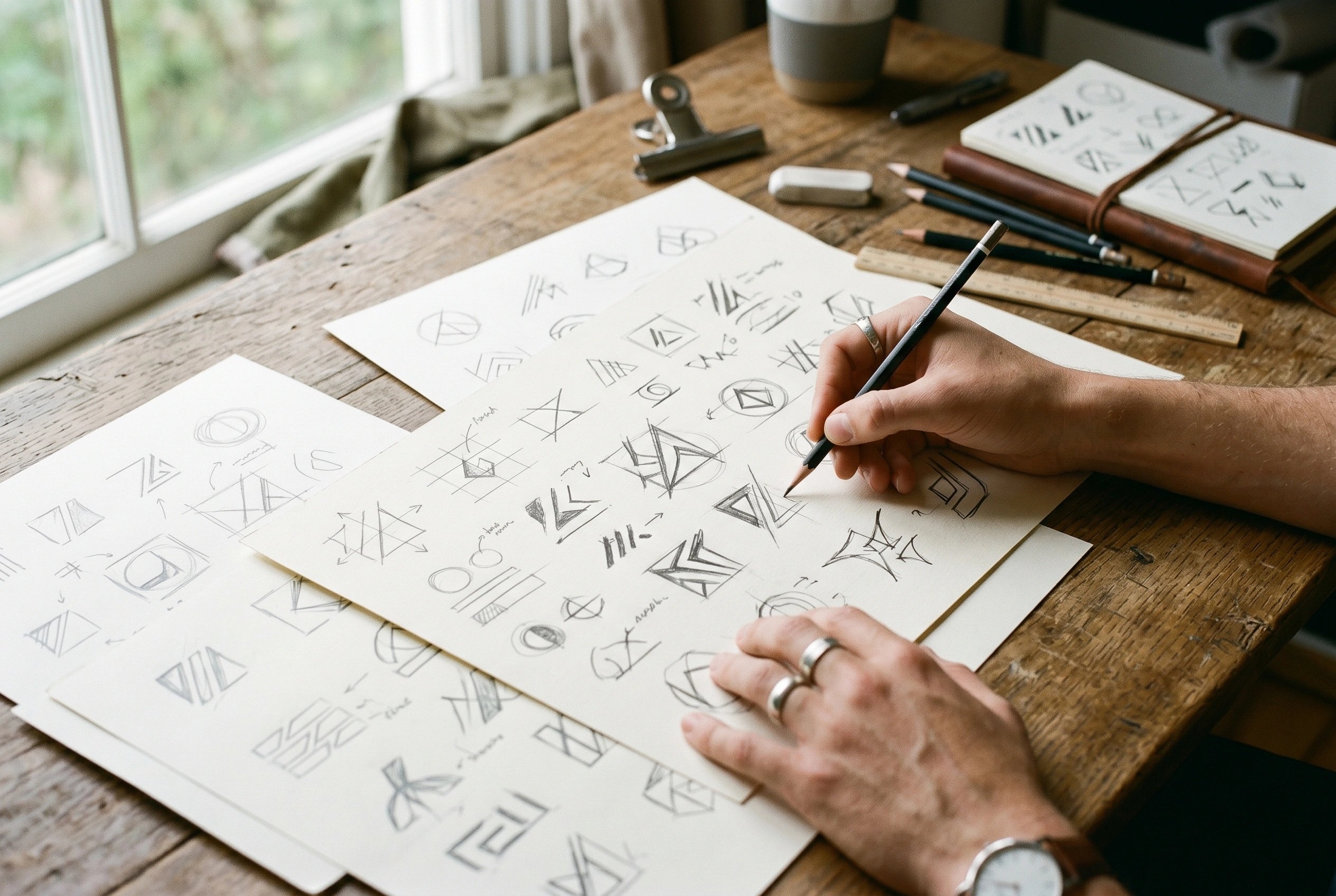
Startups that stop at the logo spend the next two years making inconsistent decisions — different typefaces on different materials, colours that drift, copy that sounds like three different people wrote it — because there is no system to hold any of it together. That is not a logo problem. It is a strategy problem that was never solved.
If you are still sorting out what the word actually means for your business, our guide to brand identity covers the full picture.
mistake 2: branding before positioning
The second mistake is starting the visual work before the strategic work is finished. We see it on almost every brief that arrives with 'we need a logo but haven't fully figured out our target customer yet'. The brief is honest, at least.
Positioning answers: who is this for, what do we promise them, and why should they believe us over the alternative? Without those answers, a designer is inventing positioning on your behalf — usually by defaulting to whatever the category currently looks like. You end up with something generic at a premium price.
The cost is a rebrand inside eighteen months, when a startup finally gets traction, narrows its audience, and realises the brand was built for a customer it no longer serves.
mistake 3: copying the category leader
Look at the Indian D2C personal-care shelf a few years ago: earthy tones, kraft textures, lowercase sans-serif wordmarks, nature photography. Every brand was signalling 'clean and honest' — which meant none of them stood out enough to be remembered.

Mamaearth built a position on clean ingredients early enough that its visual language felt distinctive. A brand launching three years later in the same palette is not borrowing credibility; it is disappearing into a crowd that already has a leader. Copying the category leader tells the customer one thing: we are a cheaper version of someone else.
The question for the brief is not 'what does this category look like?' It is 'what does this category conspicuously lack?' The answer is almost always where the differentiation lives.
mistake 4: inconsistency resets the recognition counter
Brand recognition is cumulative. Every time a customer sees you presented consistently — same colour, same tone, same visual logic — they store a small deposit of familiarity. Inconsistency withdraws it. Enough of it and you start from zero at every touchpoint.
Consistent brand presentation can lift revenue by up to 33%, according to Lucidpress/Marq's State of Brand Consistency report across 400+ organisations. That figure exists because recognition drives preference, and preference drives purchase without the customer having to think hard.
What kills consistency for startups is usually not laziness — it is the absence of a system. When the rules do not exist, every designer, social manager, and packaging vendor makes their own call, and the brand ends up looking like it cannot decide who it is.
“A cheap logo is fine. A cheap strategy is what kills you.”
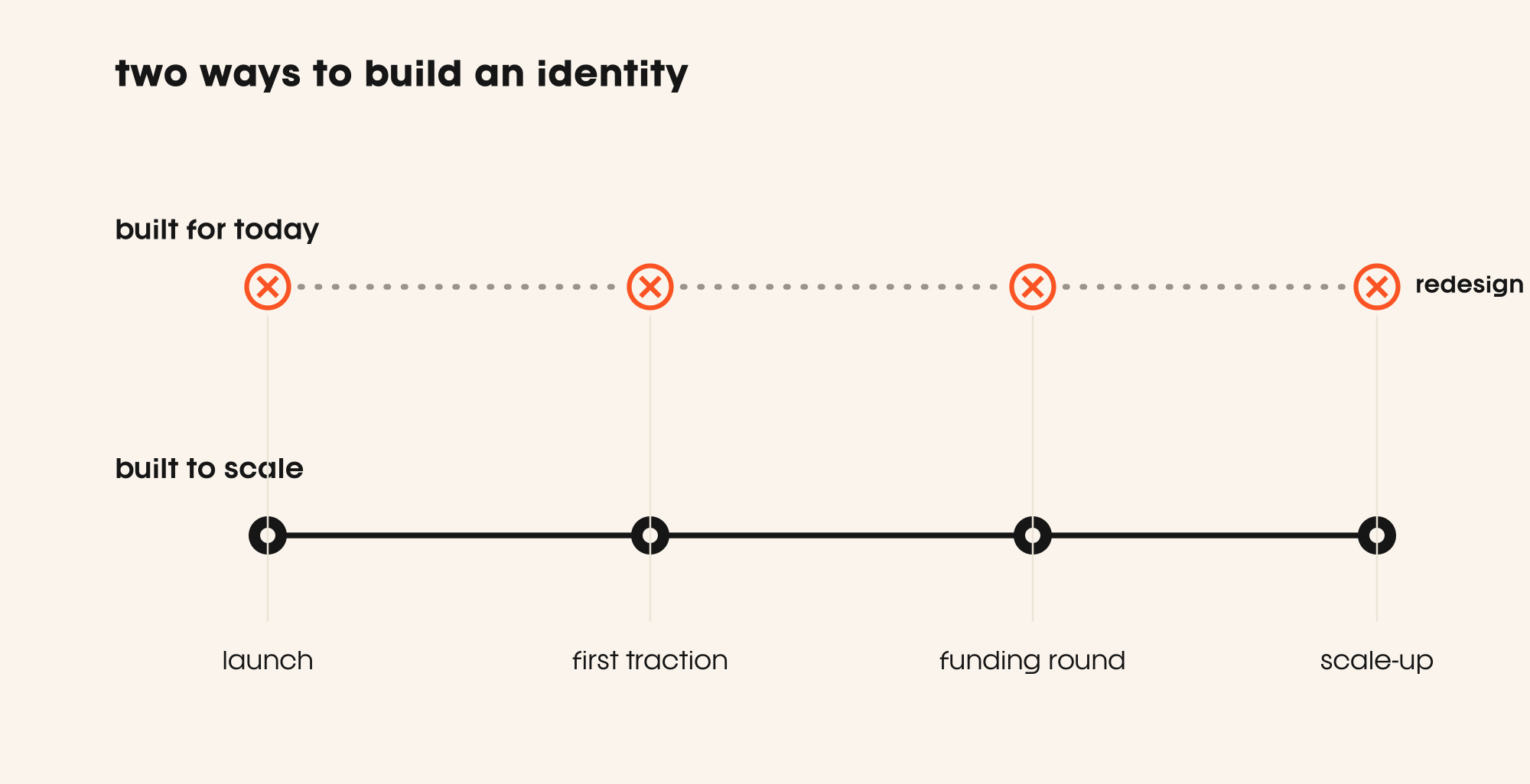
mistake 5: designing for today's startup, not the one you're building
Early-stage branding often reflects the founder's current anxiety rather than the company's actual ambition. A founder nervous about looking 'too big' underprices the identity. A founder desperate to seem legitimate over-engineers the corporate signalling and ends up looking like a law firm when they sell hot sauce.
The question we always ask: where do you want this brand to be in five years, and what would a customer think of it then? An identity built for a ten-person team that closes a Series A and hires eighty people will feel wrong immediately — because it was designed for the wrong moment.
Wakefit is a fair example: the brand has iterated as it moved from mattress-in-a-box to full home furnishings. That iteration is normal and planned. What is expensive is an identity that cannot scale at all and needs full replacement rather than evolution.
mistake 6: treating packaging and touchpoints as afterthoughts
The brand does not live in the logo file. It lives in every moment a customer meets the product — the unboxing, the app onboarding, the delivery bag, the invoice email, the returns page. Founders who treat these as operational details hand their experience design to whoever is cheapest and fastest.

Sleepy Owl built real brand equity not just through a strong wordmark but through packaging that felt considered at every level — the box structure, the filter-bag design, the insert copy. None of that is accidental. It is the result of treating every physical touchpoint as a brand decision, not a fulfilment one.
The question is not 'what does the packaging need to do technically?' It is 'what does a customer feel when they hold this?' Those two questions produce very different results.
If you want to understand what this work involves — and what it costs to do properly — our breakdown of branding costs in India is a useful reference before you brief anyone.
mistake 7: outsourcing the decision, not just the craft
This is the mistake that makes the others worse. A studio — ours included — can ask the right questions, build the right system, and execute at a high level. What we cannot do is make positioning decisions for a business we do not run. When a founder says 'just make it look good', they are outsourcing the one thing that cannot be delegated.
The craft of branding — the design execution, the visual system, the files — is exactly what you bring in specialists for. That is what we do. But the decisions about who you serve, what you promise, and what makes you worth choosing belong to the founder. A studio that does not push back on those questions is doing you a disservice.
The outcome of outsourcing the decision is a brand that looks professional but says nothing true. It will look fine in the portfolio. It will not work in the market.
quick answers
what are the most common branding mistakes startups make?
The most common is treating the logo as the complete identity, which leaves no system to create consistency across touchpoints. The second is beginning visual design before positioning is resolved, which produces generic or misdirected work.
how much does a branding mistake actually cost a startup?
It varies. An inconsistency problem that erodes recognition is hard to put a number on but directly hits conversion. A rebrand triggered by a positioning error often runs ₹5–20 lakh depending on scope — plus the lost months. The 33% consistency uplift (Marq/Lucidpress) hints at what the opposite quietly costs.
can a startup fix branding mistakes without a full rebrand?
Sometimes. Inconsistency can often be corrected by building a proper system without changing the core identity — if the core is sound. If the mistake is strategic (wrong positioning, wrong audience), a full rebrand is usually unavoidable. The earlier you catch it, the cheaper the fix.
when should a startup invest in branding?
When positioning is clear and the product is stable enough to represent honestly — ideally before you have large customer-acquisition spend behind you, because the cost of correcting a bad brand scales with how many people have already seen it.
The thread through all seven is the same: branding is a strategic decision that happens to have a visual output. Founders who treat it as a design project get a design project. Founders who treat it as a business decision get a brand that works.
filed under


got a project in mind?
we turn thinking like this into brands that actually ship. tell us what you’re working on.