contents
AI brand design tools can produce a logo, a colour palette, a type pairing, and a set of mockups in under three minutes. That is not hype — we have timed it. The honest question is not whether AI is fast; it is whether fast is what your brand actually needs. Our take: AI is the fastest intern we have ever worked with, and like most interns, it has no taste, no memory of your category, and no idea why any of the decisions it just made were decisions at all.
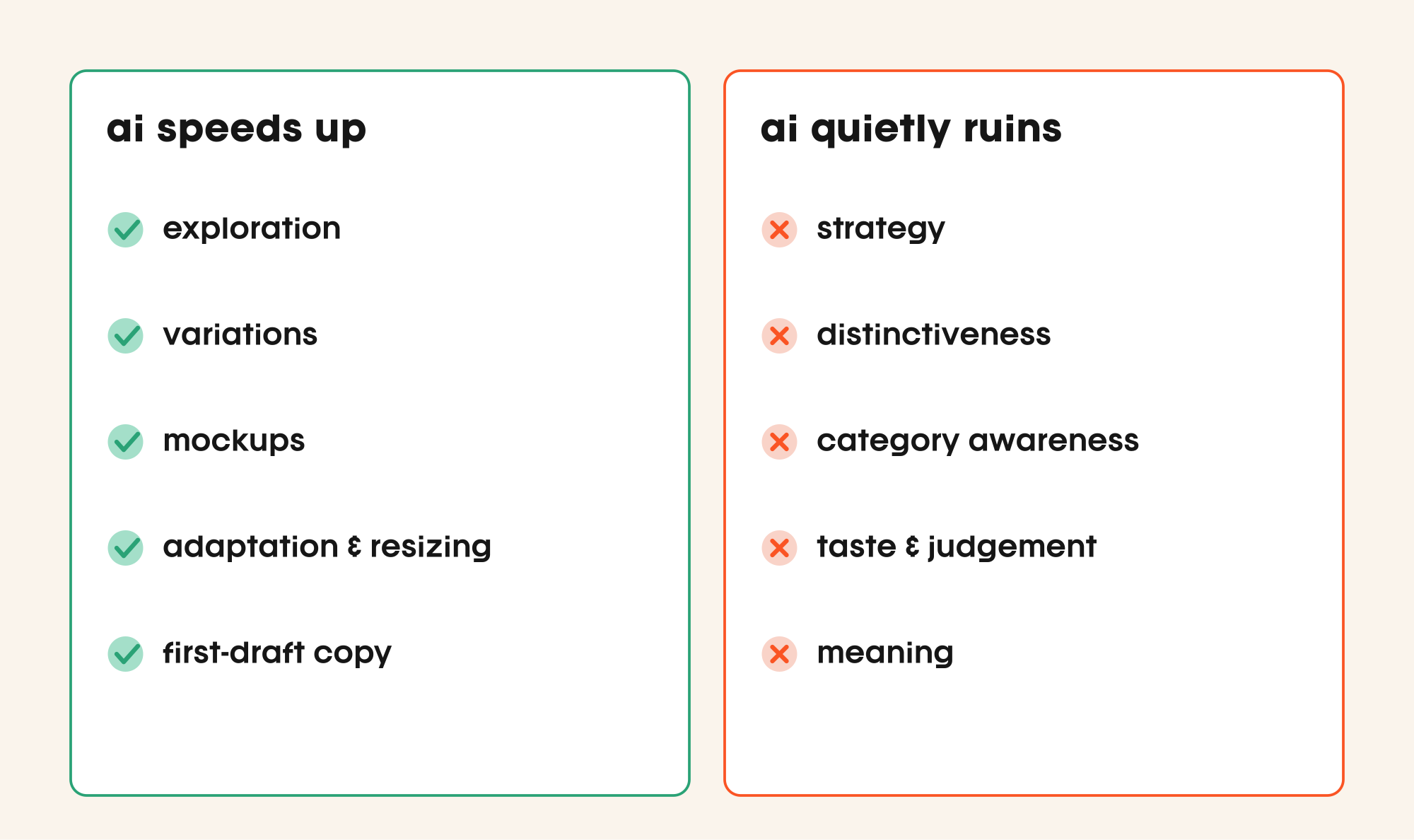
what ai genuinely speeds up
The tools worth knowing — Brandmark, Looka, uBrand, Design.com, and image models like Midjourney and Adobe Firefly — are genuinely useful for a narrow set of tasks. Early exploration is the clearest one. When a client arrives with a vague brief and we need to show three tonal directions before we have agreed on strategy, AI gets us to rough visual territory in an afternoon rather than a week.
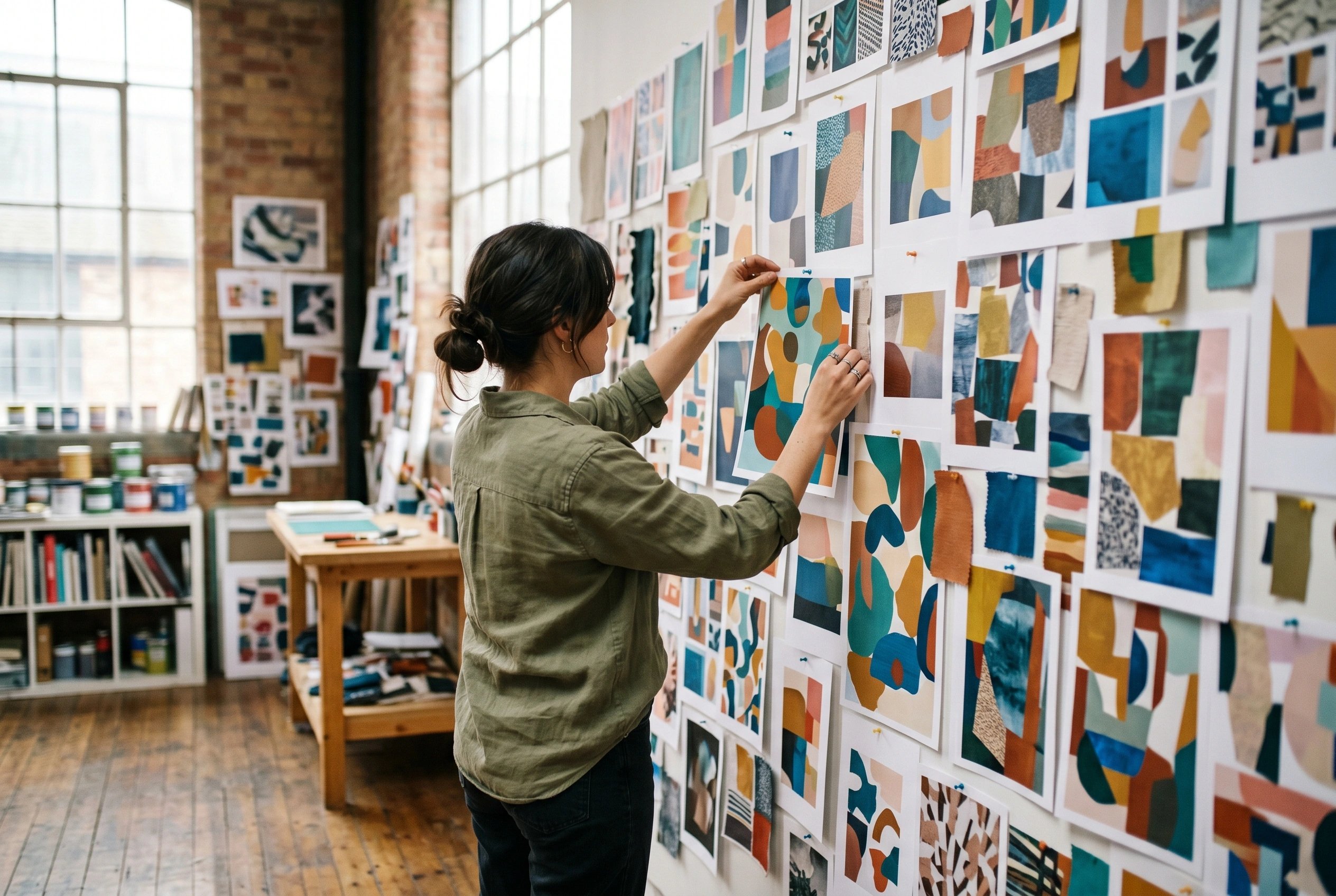
Volume is the other real win. A single touchpoint — a packaging label — might need thirty size variations for different SKUs and channels. That adaptation work used to eat days of a junior designer's time. Now it does not. We also use AI copy as first-draft scaffolding: it gives us something to argue with, which is often faster than a blank document.
Presentation mockups are legitimately excellent. Clients think in three dimensions — they want to see the logo on a bag, on a truck, on a phone. AI mockups have made our decks richer without ballooning production time. For that slice of the workflow, we are converts.
what it quietly ruins
Here is what no AI branding tool will tell you: it cannot do strategy. It does not know that your category is already owned by two legacy players in navy and gold, so the 'premium' palette it just generated is camouflage, not identity. It does not know that the founder's last business failed partly because the brand felt generic. It does not know what your brand needs to *not* look like.
Positioning is a research and argument problem before it is a visual one. What brand identity actually is is not a logo — it is a compressed answer to why you exist and who you are for. AI skips the question and hands you an answer. That is a dangerous shortcut when the question is the work.
The subtler damage is to taste. When founders use AI to generate their own brand before engaging a studio, they often lock onto the first thing that looks polished. Polished is easy now. Polished is table stakes. The hard thing — choosing what to keep, what to push, what to throw out — needs judgement earned from looking at thousands of brands in context. AI has no context. It has training data.
the sameness problem: everyone is prompting the same models
This is the part that should worry founders most. When the whole market runs its briefs through the same few models, the outputs converge. There is a particular startup logo — geometric sans-serif, muted earth palette, a subtle negative-space mark — that the tools have been producing on repeat for two years. It looked fresh in 2023. It looks like a category uniform now.

We wrote about this in relation to why flat design is over, and the mechanism is identical: when a visual language becomes the default, it stops being a signal and becomes noise. AI did not invent this problem, but it has industrialised it. Distinctiveness is now the scarce thing — and, not coincidentally, the thing AI cannot supply.
AI-generated identities all rhyme — distinctiveness is now the thing AI can't give you.
The Indian market makes this sharper. Categories here are often crowded with brands that already look and sound identical. The studio that spots the white space — the brand that can afford to look nothing like its competitors — is doing a different job than the one generating assets. That job requires someone who has studied the category, not just the brief.
how we actually use ai in the studio
We use it. Regularly. We are not precious about it. The question we ask before reaching for an AI tool is simple: does this task need judgement, or throughput? If throughput, AI. If judgement, human.

In practice: we use image models to rough out mood and texture for packaging and identity work — it shortens the conversation about surface, material, and light before we commit to anything. We use AI copy drafts to pressure-test messaging hierarchies. We use AI mockups in every client deck.
What we do not use AI for: the initial positioning, the competitive audit, the decision about what kind of brand this needs to be. We do not use it to generate final marks or final colour systems. We do not use it to decide when something is finished.
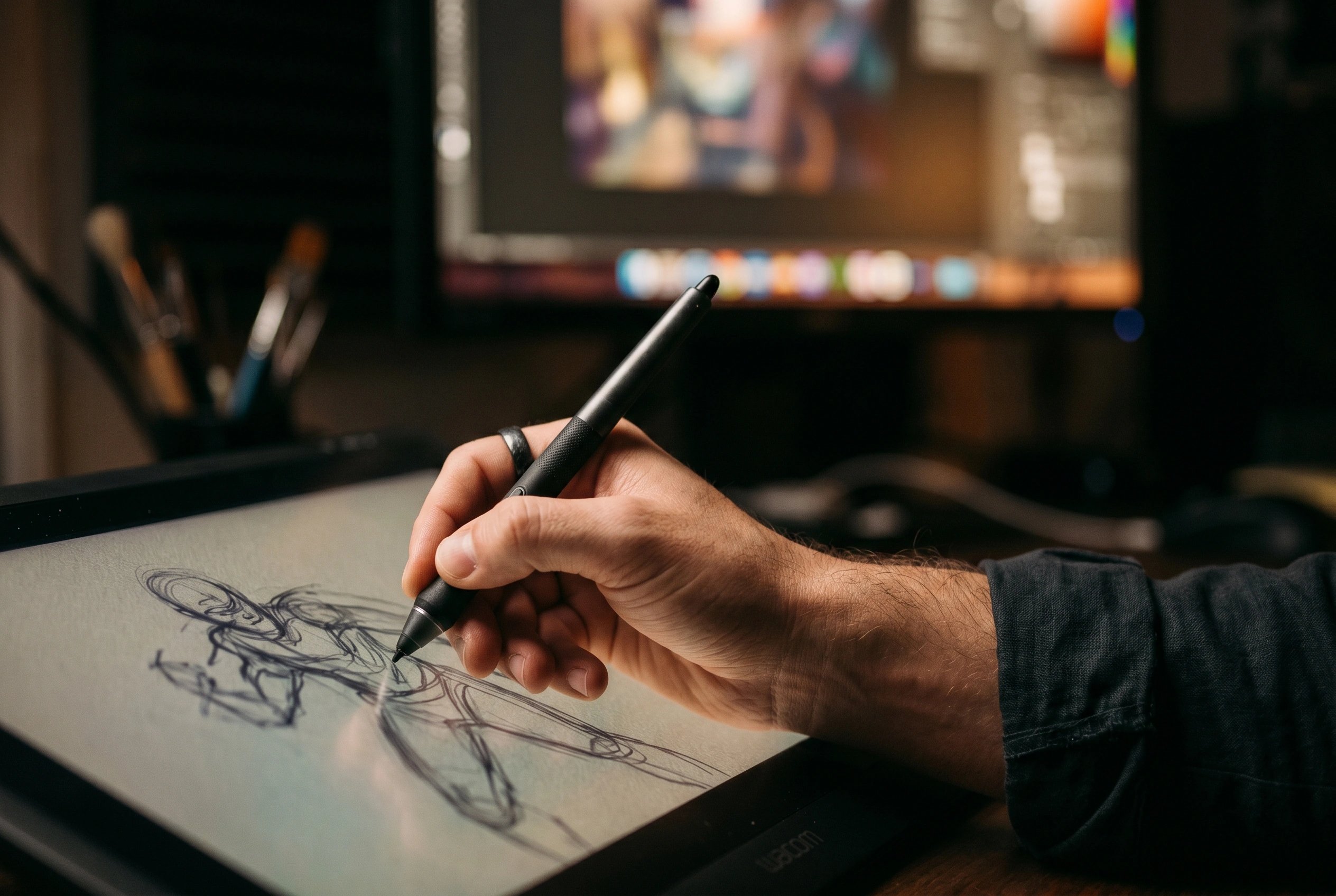
The clearest way we have found to put it: AI is fast at the things that have many right answers. Brand strategy is hard because it has very few.
“AI is the fastest intern we've ever worked with. Like most interns, it has no idea why any of the decisions it just made were decisions at all.”
quick answers
can ai design a brand?
AI can generate brand assets — logos, palettes, mockups — quickly and cheaply. It cannot design a brand strategy, which is the prior question: what position the brand should occupy, what it should feel like, and why. Assets without strategy are decoration.
is ai replacing graphic designers?
Not designers who work at the level of strategy and judgement. AI is replacing the most repetitive, throughput-heavy parts of design — resizing, adaptation, first-draft exploration. Designers doing only those tasks face real pressure. Designers who think are not going anywhere.
what are the best ai branding tools?
Brandmark and Looka are the most complete for logo-plus-kit generation; uBrand and Design.com sit in a similar lane. For image and mood work, Midjourney and Adobe Firefly are the ones we see most. None of them replace a brief, a competitive audit, or a point of view.
is ai in branding worth it for a small business?
As a starting point or placeholder, yes — the cost is low and the output is presentable. As a finished brand for a business that wants to be distinctive, no. The risk is not that AI produces something bad. It is that it produces something that looks exactly like your three nearest competitors.
The thing worth protecting in any brand project is not the logo file. It is the thinking that made the logo the right answer. That thinking is still entirely human work — and it is the part that compounds over time.


got a project in mind?
we turn thinking like this into brands that actually ship. tell us what you’re working on.