contents
Brand voice examples are everywhere — Zomato push notifications, Amul hoardings, Oatly cartons that argue with you. What is not everywhere is a brand that has actually decided its voice and made it usable. Most founders can describe their brand in adjectives. Almost none can hand a new hire a sentence and say: this is how we sound, and here is why.
voice is the cheapest differentiation available in india right now
Here is the honest mechanism. You are already writing everywhere — your website, your order-confirmation emails, your support macros, your packaging, your Instagram captions. You are producing voice whether you have decided it or not. The question is whether that voice is an accident or a choice.

In most Indian categories, it is an accident. Open five competing D2C skincare brands and read their About pages. You will find the same words — 'clean', 'conscious', 'effective', 'for the modern Indian' — in slightly different orders. The voice is indistinguishable because nobody decided it. They reached for the category default and stopped.
A decided voice costs almost nothing to implement, because the writing is happening anyway. You are not adding a channel — you are adding a rule to an existing one. That is why voice is the cheapest differentiation available: the infrastructure already exists. You are just replacing random with deliberate.
the sameness trap: why every fintech and d2c sounds identical
The trap has a pattern. A new brand launches, hires a content writer, and tells them: we are 'trustworthy, innovative, customer-first'. The writer produces copy. It is competent. It sounds like every other brand in the category, because those adjectives describe every brand in the category — or rather, the aspiration every brand has for itself, which is not the same thing.
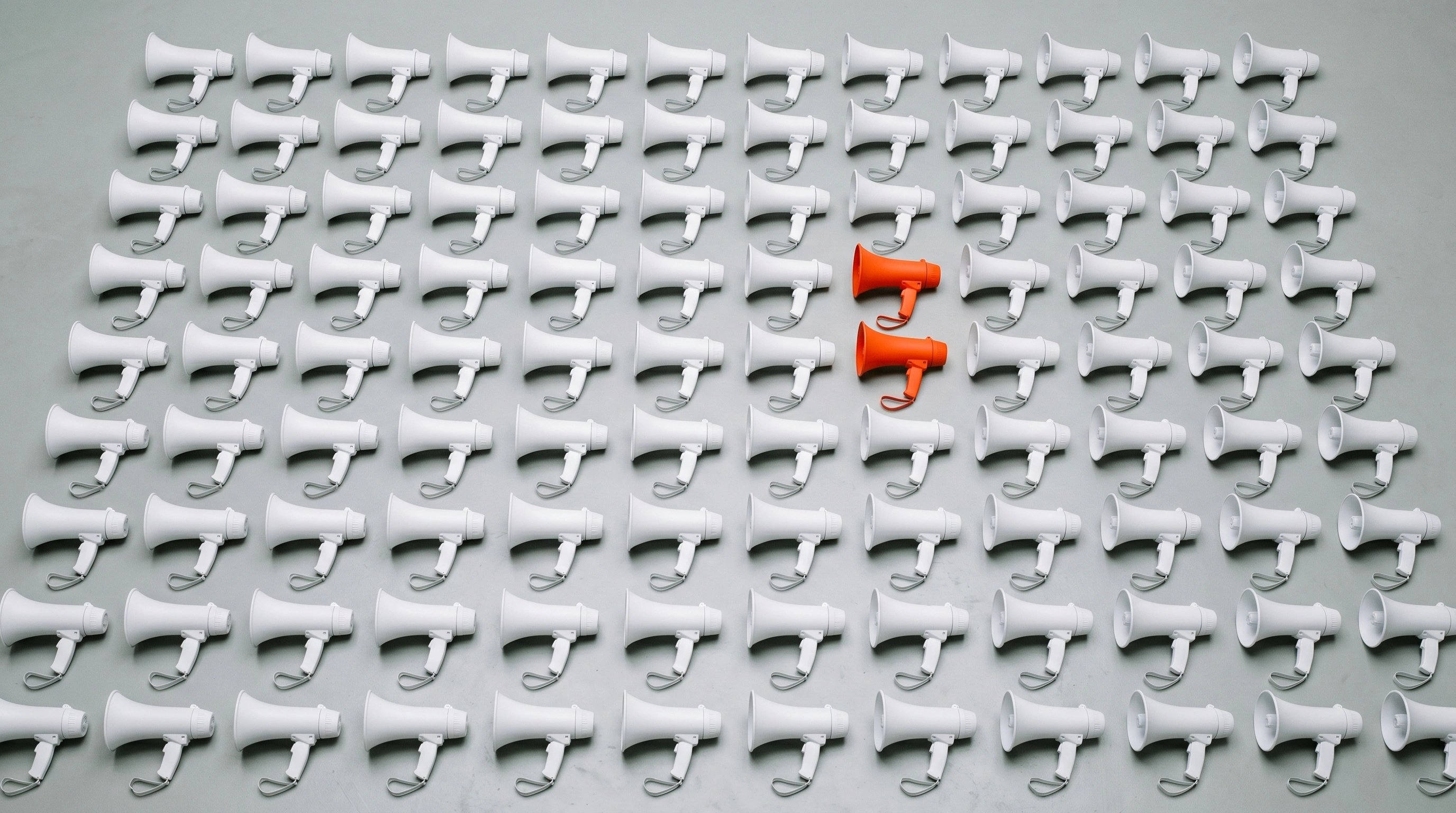
Fintech is the worst offender in India right now. The category has a distinct house voice: reassuring, jargon-light, vaguely aspirational, orange or blue. Every new entrant sounds trained on the same corpus. When one runs a campaign, you could swap the logo with three competitors and nobody would notice.
This is not a content problem. It is a strategy problem. Voice is a positioning decision, and it belongs in the same conversation as your price point and your distribution. Treat it as a cosmetic layer the agency handles in the final week and you will get the category default — because that is what happens when nobody decides.
This is one of the 7 branding mistakes startups make we see repeatedly: voice gets deferred until after launch, then never revisited, then baked into everything so thoroughly that changing it feels impossible.
brand voice examples worth stealing from
The brands worth studying are not the ones with beautiful decks. They are the ones where you can read a single line and know immediately who wrote it.
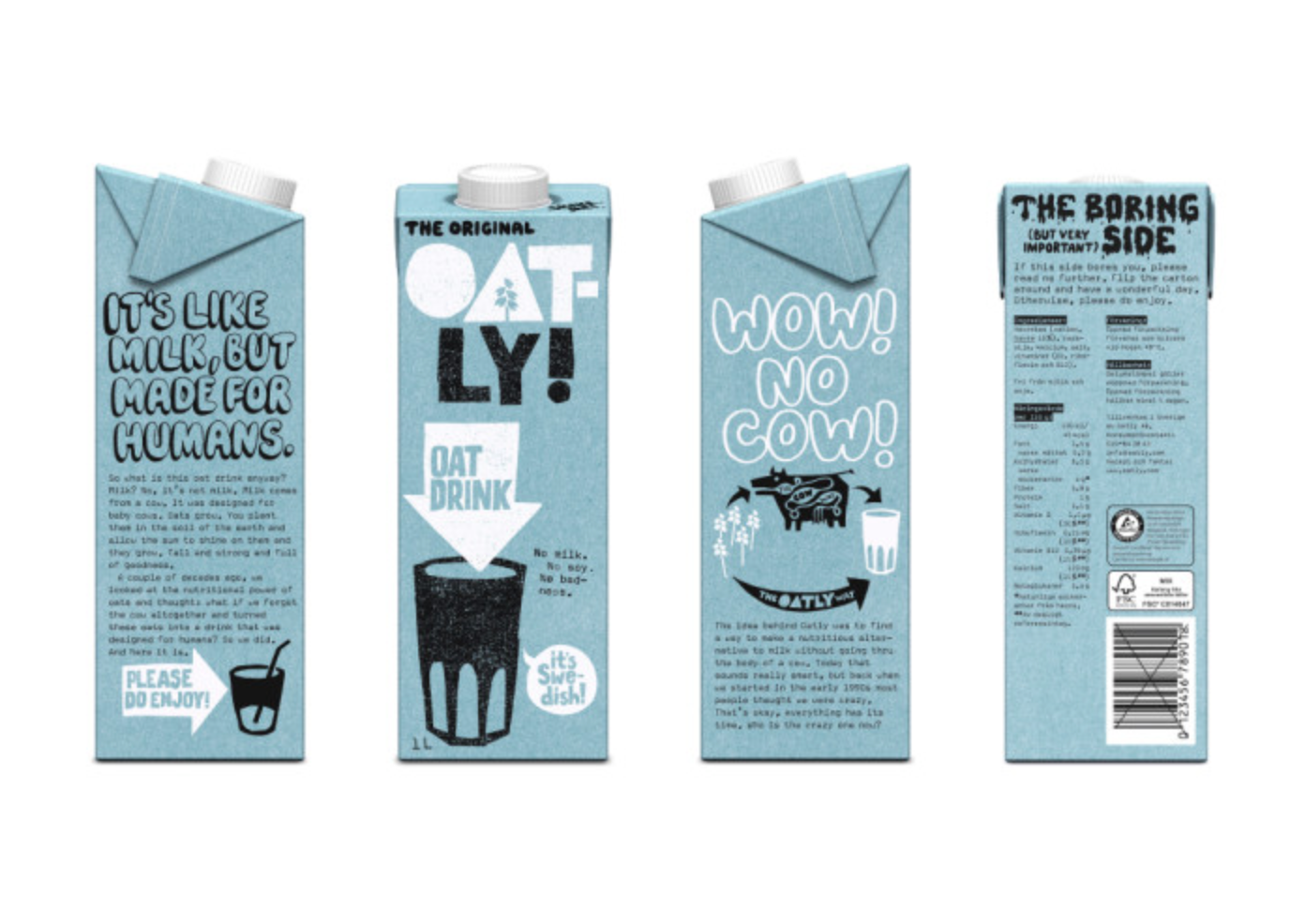
- Oatly — argumentative, self-aware copy on every surface, including what they call 'the boring side' of the carton. The packaging literally debates the reader. It works because the rule is simple: talk to the customer like a slightly eccentric friend with strong opinions about dairy.
- Mailchimp — clear, warm, never condescending. They made an email-marketing product feel like it was written by someone who had actually used email marketing and found it stressful. Their voice guide is famously specific about what they are *not*: not hip, not corporate, not a robot.
- Innocent Drinks — chatty, playful, sneaking real information into copy that reads like a conversation. The bottles sound like they were written by someone who wanted to be your friend and happened to know a lot about fruit.
- Amul — topical wit since 1966. The hoarding became a cultural institution not because of the butter but because of the wordplay — a decided voice held consistent across six decades.
- Blinkit — cheeky, confident, occasionally absurdist billboard one-liners. They understood early that quick commerce is partly entertainment, and their outdoor copy earns screenshots the way Zomato's notifications do.
- Slack — concise, friendly, human. Slack's error messages and empty states are cited as voice exemplars because they turned system copy — the part every brand ignores — into a personality moment.
The pattern across all of them: the voice is expressed in the places most brands treat as afterthoughts. Error messages. Order confirmations. The back of the pack. The notification at 11pm. That is where you find out whether a voice is real or decorative.
what zomato actually built was a tone system, not a jokes account
Zomato built a national brand on tone alone for years — push notifications and billboards in a voice so distinct that screenshots of their copy became free distribution. Other brands replied in kind. News accounts picked up the exchanges. The voice became the story.
What made it work was not the wit. It was the consistency of the system. Zomato's voice has a logic: it speaks to you like a slightly irreverent friend who knows you are hungry and will not waste your time being polite about it. That logic held across notifications, out-of-home, social, and support. When a brand is consistent at that level, the voice becomes recognisable before you see the logo.
The lesson is not 'be funny'. Most brands that try to be funny online land somewhere between embarrassing and invisible. The lesson is that Zomato made a system — a set of rules any writer on the team could apply — and shipped it consistently across every touchpoint. That is a tone system. It is different from a tone-of-voice deck, which is a document.
Voice is one of the six elements of what brand identity actually is. But unlike colour or typeface, it has to be re-executed by a different person every time someone writes something. Which is why rules beat adjectives every time.
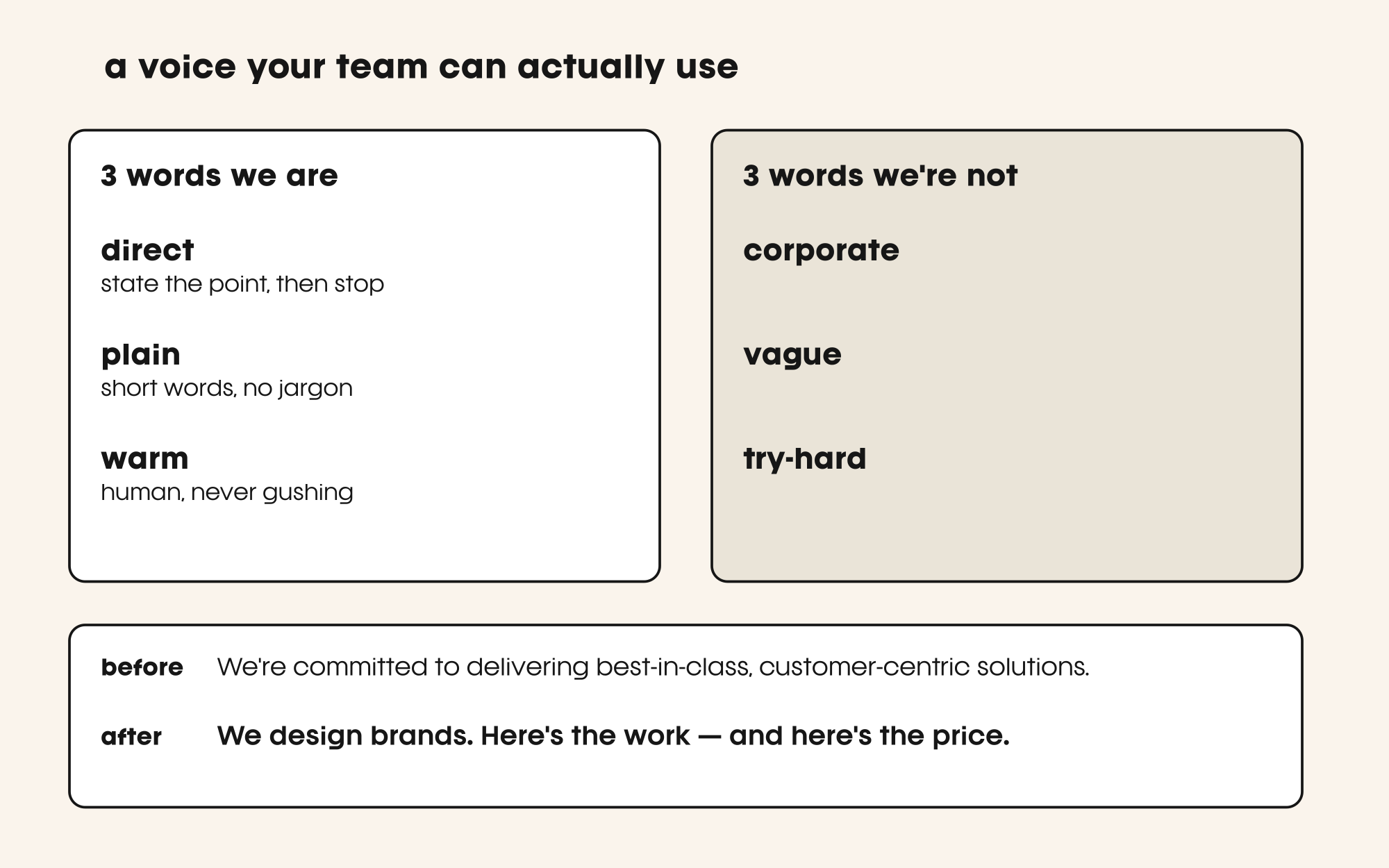
how to write a voice your team can actually use
Tone-of-voice decks die in Drive — ship a voice as rules, not adjectives. Here is the method we use with clients, stripped to its working parts.
Step one: pick three words you are and three you are not. Not aspirational adjectives — actual behavioural descriptors. 'Warm' is not useful. 'Warm but never sycophantic' is a rule. 'Bold' tells a writer nothing. 'Bold: we state opinions directly and don't hedge' tells them exactly what to do. The 'not' column is frequently more useful than the 'are' column, because it closes off the category defaults.
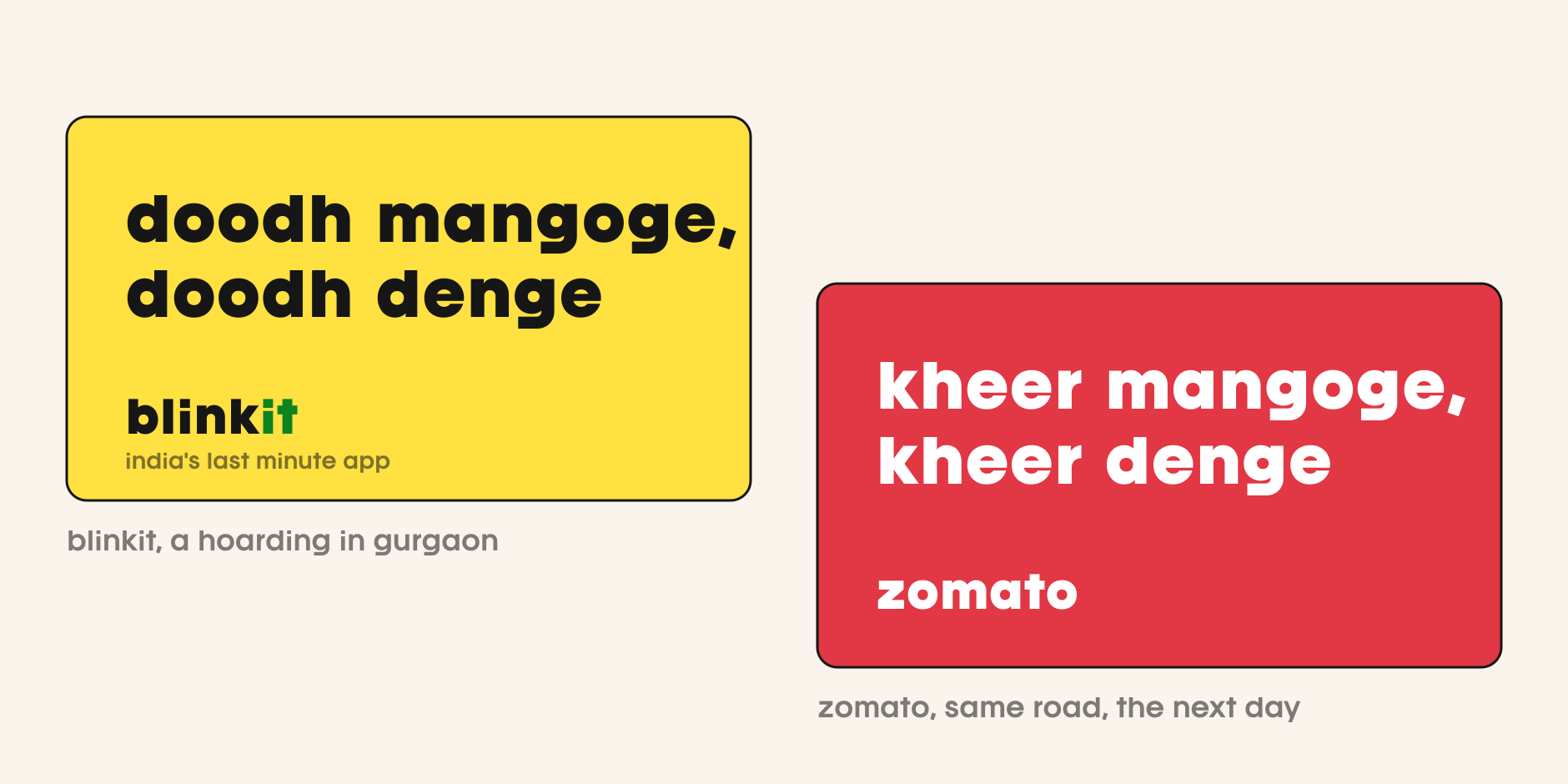
Step two: write before-and-after example sentences. Take a real line your brand has published — a product description, an email subject, a support reply — and rewrite it in the new voice. The before/after pair is worth a hundred adjectives, because it shows the voice in operation. A new hire can pattern-match against an example. They cannot pattern-match against 'approachable'.
Step three: ship the rules, not the deck. A one-page voice guide with three rules, three anti-rules, and four before/after examples will outlive a forty-slide deck every time. Put it in the onboarding doc. Pin it in the channel where copy gets reviewed. Make it impossible to lose.
The brands that maintain voice over years — Amul, Oatly, Mailchimp — are not the ones with the best designers. They are the ones where any new writer can read the guide, write a line, and be approximately right. That is the bar. Not perfection. Executable.
If you want help building that guide, the work we do includes voice as a deliverable inside brand identity — not an afterthought, and not a slide deck you will never open.
quick answers
what is brand voice?
Brand voice is the consistent personality your brand expresses across all written and spoken communication. It is not a tone or a mood — it is the underlying identity that stays stable whether you are writing a push notification or a packaging panel.
what is the difference between brand voice and tone?
Voice is constant; tone is situational. Your brand's voice does not change — its personality is the same in a complaint response as in a campaign headline. Tone adjusts to context: more restrained in a crisis, more playful in a celebration. Same voice, different register.
how do i define my brand voice?
Start with the three-words-you-are / three-words-you're-not exercise above. Then write before-and-after example sentences using real copy you have already published. Do not start from a blank brief — start with copy that exists and ask whether it sounds like you. The gap between your current copy and your desired voice is your brief.
why do brand voice decks not get used?
Because they are written for approval, not execution. A fifty-slide deck with moodboards and philosophy is a pitch document. A writer on a deadline needs a rule and an example, not a manifesto. Ship the one-pager. Archive the deck.
The brands that get voice right — in India and globally — are not more creative than the ones that get it wrong. They made a decision, wrote it down in a form someone could actually use, and shipped it. That is available to every brand. Most just have not done it yet.
filed under


got a project in mind?
we turn thinking like this into brands that actually ship. tell us what you’re working on.